Ingredients
Equipment
Method
- Wash 1 head green cabbage well and remove and save aside the outer leaves. Use a chef's knife or other large sharp knife to cut the head into quarters on a cutting board. Cut the core of the cabbage from each quarter and save those aside as well. Then, carefully slice each quarter into thin pieces (about ⅛" to ¼" wide) and place in a large bowl. Sprinkle 1 tablespoons sea salt over the sliced cabbage and let it sit uncovered at room temperature for about 15-20 minutes.
- Using clean hands, massage 1 tablespoons sea salt into the cabbage for several minutes until the cabbage starts to "sweat" and release its juices into the bowl. Keep massaging for another 5-10 minutes until you are left with a nice brine of juice in the bottom of the bowl.
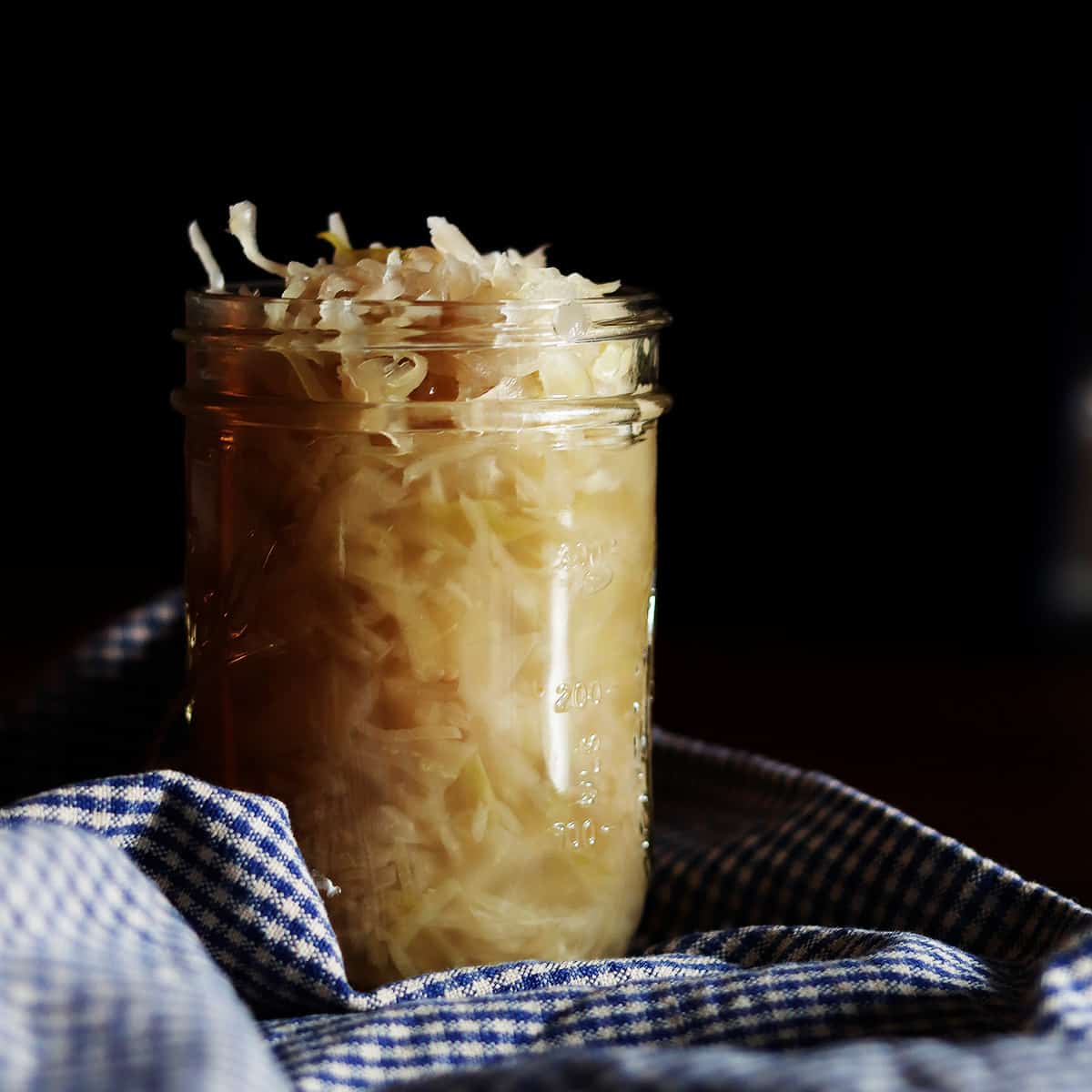
- In a quart-sized Mason jar, add handfuls of cabbage at a time, making sure to pack it in the jar as tightly as possible to ensure there are no air pockets. If necessary, you can use a second smaller jar to hold any cabbage that didn't fit into the main jar. Pour in any remaining brine from the bowl over the cabbage, leaving at least an inch of space between the top of the brined cabbage and the top of the jar.
- If you were able to produce enough brine from massaging to cover your sliced cabbage completely, you can skip this step. If not, add the other tablespoon of sea salt into a slightly warmed quart of filtered water. Stir until completely dissolved and cool back down to room temperature. Slowly pour just enough salt water brine into your cabbage jar until the liquid completely covers the cabbage, making sure to leave an inch of space below the top of the jar.
- If the packed cabbage doesn't stay submerged and some pieces float to the top, use one or more pieces of the core of the cabbage to wedge into the jar and keep your cabbage completely submerged, or use part of an outer leaf to tuck everything back under the brine. (You can also use a fermentation weight for this.) Cover your jar with a regular lid or fermentation lid if you have one (see notes).
- Set your Mason jar on a saucer or in a small tray on the counter and away from direct sunlight for a week (inside a cabinet is fine too.) You'll want to make sure that the ambient temperature is between 65-70°F (18-21°C) for successful fermentation to occur. (The saucer or tray is helpful to collect anything that might bubble over during the fermentation process.) Open the jar after one day to make sure the cabbage is still submerged, and push everything back under the brine if necessary. If you're using a regular lid, continue to open the jar once a day to "burp" your ferment and allow any gasses to escape, then reseal it; there is no need to do this with a fermentation lid. Take a first taste at the one-week mark; if you prefer a stronger flavor, keep fermenting and test again in another day or two for up to another week, or for up to 1-2 months if you prefer a very strong flavor.
- Once you're happy with the taste, place the jar in the refrigerator to end the fermentation process, and enjoy!
Nutrition
Notes
Sea salt: The right kind of salt is very important when it comes to fermentation. Don't use table salt or iodized salt; instead, look for any kind of fine ground sea salt or pickling salt.
Fermentation lids and weights: You can buy special fermentation lids (on Amazon, etc.) that will let your sauerkraut "breathe" while you ferment and avoid any overflows. While these are not essential, they do help make things go more smoothly especially if you're just starting out fermenting. You can also buy fermentation weights to help keep veggies submerged under water during the fermentation process. Appearance/smell: If you see any signs of mold on a piece of cabbage that wasn't fully submerged, you can remove that section and continue on as long as the rest of the ferment looks and smells fine. However, if you see strange discoloration or if your sauerkraut develops a smell that seems "off" or spoiled, it's best to play things safe and start over with a fresh batch. The more you practice fermenting cabbage and other vegetables, the easier it will get. And don't feel bad; even the sauerkraut-making gurus get a bad batch once in a while. Storage: Homemade sauerkraut will stay fresh for up to 3 months in the fridge.
Fermentation lids and weights: You can buy special fermentation lids (on Amazon, etc.) that will let your sauerkraut "breathe" while you ferment and avoid any overflows. While these are not essential, they do help make things go more smoothly especially if you're just starting out fermenting. You can also buy fermentation weights to help keep veggies submerged under water during the fermentation process. Appearance/smell: If you see any signs of mold on a piece of cabbage that wasn't fully submerged, you can remove that section and continue on as long as the rest of the ferment looks and smells fine. However, if you see strange discoloration or if your sauerkraut develops a smell that seems "off" or spoiled, it's best to play things safe and start over with a fresh batch. The more you practice fermenting cabbage and other vegetables, the easier it will get. And don't feel bad; even the sauerkraut-making gurus get a bad batch once in a while. Storage: Homemade sauerkraut will stay fresh for up to 3 months in the fridge.
