

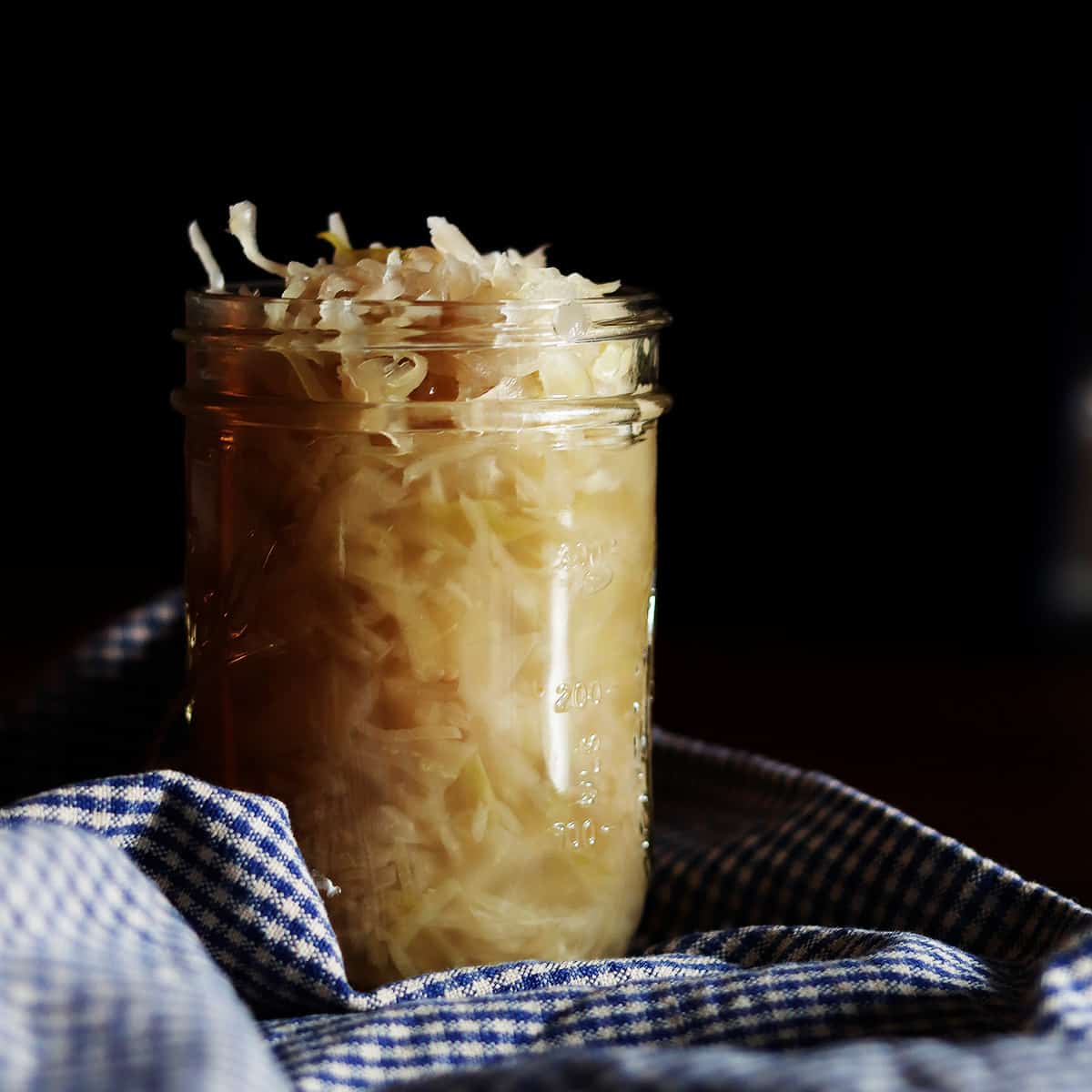
If you've landed here wanting to learn how to make sauerkraut at home (and without any fuss!) you're in the right place. This classic fermented cabbage recipe is both delicious and EASY to make, and it's 100% worth the fermentation time. 😉

"I am impressed with your recipes, they are how I remember them from when I was in Germany!"
- Paul Louis, One Happy Dish reader
Traditional sauerkraut is such a timeless culinary treasure, and one which you'll definitely want to have on hand, whether or not you make it from scratch. Originating in China over 2,000 years ago and becoming a German staple in more recent times, fermented sauerkraut been passed down to us through the generations and has been used in so many different ways. I personally love using it in my lunch for one recipes for a quick pop of flavor.
The best part of all? This homemade sauerkraut recipe is surprisingly easy (and so rewarding to make!) It requires only two simple ingredients, one jar, and a quiet spot to ferment on the counter for a week or two. And if you're working in a small kitchen like me, this small batch recipe is super easy to manage.
Did you know?
Sauerkraut, or fermented cabbage, is arguably one of the most beloved fermented foods on the planet. It is made by using only salt to create a watery brine around the cabbage and then letting the natural microbes on the cabbage proliferate and change the nutritional profile and flavor of the cabbage into the something truly enchanting through a process called lacto-fermentation.
🌿 Ingredients
As promised, the ingredients you'll need to make sauerkraut are SO simple: just cabbage and sea salt.
Green cabbage is the vegetable of choice for traditional sauerkraut, but red cabbage is equally delicious. You'll want to look for the freshest head of cabbage you can find, organic if possible, and one that weighs about two pounds for this recipe.
Pro tip: Using sea salt is actually very important to the natural fermentation process, since many table salts contain iodine or anti-caking agents which can interfere with fermentation. Alternatively, you can use kosher salt or pickling salt which are also additive-free.
📝 Instructions


✔️ Tips for success
If you are just getting started with fermentation or want to learn more about the science of why it works, I highly recommend reviewing this guide on how to ferment vegetables.
Start with a clean work area
Make sure all of your kitchen surfaces, appliances and jars (and your hands!) are clean for a successful ferment. While the fermentation process itself will kill of some unwanted bacteria, we want to make sure to minimize the chances of extra undesirable bacteria sneaking into our ferment along the way and crashing the party. 😉
Sauerkraut salt ratio
The salt to cabbage ratio for sauerkraut is fairly critical to a successful ferment. If you use too little salt, unwanted bacteria may outnumber the beneficial bacteria and potentially lead to spoiled sauerkraut. On the other hand if you use too much salt, the process is slowed down and your sauerkraut could be too salty. A good rule of thumb is about to use about 2-2.5% salt by weight. This equals roughly 1 tablespoon of salt per 2 pounds of cabbage.
Optional equipment
One of the most important steps in lacto fermentation is making sure that your vegetables are not exposed to air in any way. This includes air bubbles within the jar and making sure that no cabbage pieces are poking up through the surface. There are a few ways you can make sure this doesn't happen. If you have fermentation weights (affiliate link), you can place one on top of your cabbage. If not, you can also use one or more pieces of the core of the cabbage and wedge those into the jar to keep your cabbage submerged. Or, use an outer leaf to tuck everything back under the brine.
You can also use a fermentation lid (affiliate link) to close the jar, but a regular lid is fine too. The advantage of a fermentation lid is that it'll allow your ferment to "breathe" without you having to open it to release the gases each day.
Ideal temperature for fermentation
Make sure that the ambient temperature in your kitchen is between 65-70°F (18-21°C) and your fermentation should go smoothly. (If things are too cold, fermentation might not be able to occur. Too warm, and that could lead to mushy sauerkraut from the process going too quickly.)
How long to ferment sauerkraut
The answer for the ideal fermentation time for sauerkraut is "it depends", but generally most ferments take between one week and one month depending on your preference for a more mild vs stronger taste (the longer the fermentation time, the stronger the flavor.)
📖 Variations
There are so many ways to mix your sauerkraut recipe up! Below are some ideas to get you started. And of course, feel free to get creative and mix and match some of the ideas below, or test out your own add-ons.
- Red cabbage sauerkraut - swap green cabbage for red cabbage; it's equally delicious!
- Napa cabbage sauerkraut - use Napa cabbage instead of green cabbage for a slightly milder and delicate sauerkraut (fun fact: Napa cabbage is the cabbage variety preferred for making traditional kimchi)
- Sauerkraut with caraway seeds - sprinkle between 1 and 2 teaspoons of caraway seeds on your cabbage when you sprinkle the salt on; this traditional seasoning creates a subtle and savory flavor addition
- Sauerkraut with juniper berries - add up to a tablespoon of juniper berries when you add the salt to your cabbage, instead of or in addition to caraway seeds (dried juniper berries are available in the spice section of most large grocery stores)
- Garlic sauerkraut - layer in one or more peeled and very thinly sliced garlic cloves while you add cabbage to your jar; start with just one clove for your first ferment as a little can go a long way
- Sauerkraut with carrots - replace ½ pound of the cabbage with ½ pound of shredded carrots; this is a delicious variation on regular sauerkraut, with some added nutrition from the carrots
🥧 Serving suggestions
Looking for ways to use your homemade sauerkraut? A couple of my favorites are this tuna and sauerkraut sandwich or this sauerkraut salad side dish. More traditional uses of kraut include dishes with pork and sausage like kielbasa. And some fun and classic foods include hot dogs and Reuben sandwiches, or these delicious latkes with beet kraut.
💭 FAQ
Make sure the room you're placing your sauerkraut is warm enough to support the fermentation process, ideally between 65°F and 75°F. Also, it's possible that you didn't use enough salt necessary to trigger natural fermentation; make sure you're using a 2% - 2.5% ratio of salt to cabbage in order to achieve the right fermentation environment.
If you find your sauerkraut bubbling over it may simply be that you packed too much cabbage into your jar. Place a saucer or shallow tray underneath your jar to contain any overflow. It may also be an indication that your room is too warm and the fermentation process is going too quickly. In that case, try moving your jar to a cooler spot.
🍳 Recipe
Ingredients
Equipment
Method
- Wash 1 head green cabbage well and remove and save aside the outer leaves. Use a chef's knife or other large sharp knife to cut the head into quarters on a cutting board. Cut the core of the cabbage from each quarter and save those aside as well. Then, carefully slice each quarter into thin pieces (about ⅛" to ¼" wide) and place in a large bowl. Sprinkle 1 tablespoons sea salt over the sliced cabbage and let it sit uncovered at room temperature for about 15-20 minutes.
- Using clean hands, massage 1 tablespoons sea salt into the cabbage for several minutes until the cabbage starts to "sweat" and release its juices into the bowl. Keep massaging for another 5-10 minutes until you are left with a nice brine of juice in the bottom of the bowl.
- In a quart-sized Mason jar, add handfuls of cabbage at a time, making sure to pack it in the jar as tightly as possible to ensure there are no air pockets. If necessary, you can use a second smaller jar to hold any cabbage that didn't fit into the main jar. Pour in any remaining brine from the bowl over the cabbage, leaving at least an inch of space between the top of the brined cabbage and the top of the jar.
- If you were able to produce enough brine from massaging to cover your sliced cabbage completely, you can skip this step. If not, add the other tablespoon of sea salt into a slightly warmed quart of filtered water. Stir until completely dissolved and cool back down to room temperature. Slowly pour just enough salt water brine into your cabbage jar until the liquid completely covers the cabbage, making sure to leave an inch of space below the top of the jar.
- If the packed cabbage doesn't stay submerged and some pieces float to the top, use one or more pieces of the core of the cabbage to wedge into the jar and keep your cabbage completely submerged, or use part of an outer leaf to tuck everything back under the brine. (You can also use a fermentation weight for this.) Cover your jar with a regular lid or fermentation lid if you have one (see notes).
- Set your Mason jar on a saucer or in a small tray on the counter and away from direct sunlight for a week (inside a cabinet is fine too.) You'll want to make sure that the ambient temperature is between 65-70°F (18-21°C) for successful fermentation to occur. (The saucer or tray is helpful to collect anything that might bubble over during the fermentation process.) Open the jar after one day to make sure the cabbage is still submerged, and push everything back under the brine if necessary. If you're using a regular lid, continue to open the jar once a day to "burp" your ferment and allow any gasses to escape, then reseal it; there is no need to do this with a fermentation lid. Take a first taste at the one-week mark; if you prefer a stronger flavor, keep fermenting and test again in another day or two for up to another week, or for up to 1-2 months if you prefer a very strong flavor.
- Once you're happy with the taste, place the jar in the refrigerator to end the fermentation process, and enjoy!
Nutrition
Notes
Fermentation lids and weights: You can buy special fermentation lids (on Amazon, etc.) that will let your sauerkraut "breathe" while you ferment and avoid any overflows. While these are not essential, they do help make things go more smoothly especially if you're just starting out fermenting. You can also buy fermentation weights to help keep veggies submerged under water during the fermentation process. Appearance/smell: If you see any signs of mold on a piece of cabbage that wasn't fully submerged, you can remove that section and continue on as long as the rest of the ferment looks and smells fine. However, if you see strange discoloration or if your sauerkraut develops a smell that seems "off" or spoiled, it's best to play things safe and start over with a fresh batch. The more you practice fermenting cabbage and other vegetables, the easier it will get. And don't feel bad; even the sauerkraut-making gurus get a bad batch once in a while. Storage: Homemade sauerkraut will stay fresh for up to 3 months in the fridge.
Skip
How can I make this shelf stable, as in pressure canning or water bath? Thanks for any information. I love sauerkraut and am definitely going to give this a try.
Allison
Thanks for reaching out Skip! While this recipe focuses on just the fermentation process, you could definitely preserve it to make it shelf stable as well. Water bath canning is generally considered the best preservation method here since sauerkraut is acidic enough to prevent bacterial growth; just make sure the pH of your kraut is 4.6 or lower. Once your sauerkraut is done fermenting, you can follow the steps listed at https://nchfp.uga.edu/how/ferment/recipes/sauerkraut/ starting at the Hot pack or Raw pack canning section and using the table to adjust the processing time depending on the method you prefer and your elevation. For more info on water bath canning you can refer to https://www.ballmasonjars.com/water-bath-canning.html. Hope this helps; happy fermenting!
Paul Louis Papke
I am impressed with your recipes, they are how I remember them from when I was in Germany! I was wondering if you had ever heard of a kind of bar food, it sounded like they were calling it “Lucia’s Toast”, I only remember that it was a piece of toast with ham, pimento, might of had some kind of sauce in it, then it was covered with Swiss or Mozzerella cheese and baked until everything was good and hot and the cheese melted! Have you ever heard of anything like that? I used to get it in a Ghast Hous in Ludwigsburg, near Stuttgart! If you have heard of it, please email me recipe! I would sure appreciate it very much! Danke!
Allison
Thanks so much for the nice comment Paul! It means a lot, truly. Oooh what you're describing sounds delicious. I haven't heard of this exact sandwich but it does remind me of a Croque Monsieur. You could add some pimentos to the sandwich, or use pimento cheese in addition to or instead of the béchamel sauce that it calls for?
Here are a couple links you can try:
https://www.recipetineats.com/croque-monsieur-french-ham-cheese-sandwich/
https://www.seriouseats.com/sandwiched-grilled-pimento-cheese-ham-and-hom
Hope this helps! 🙂